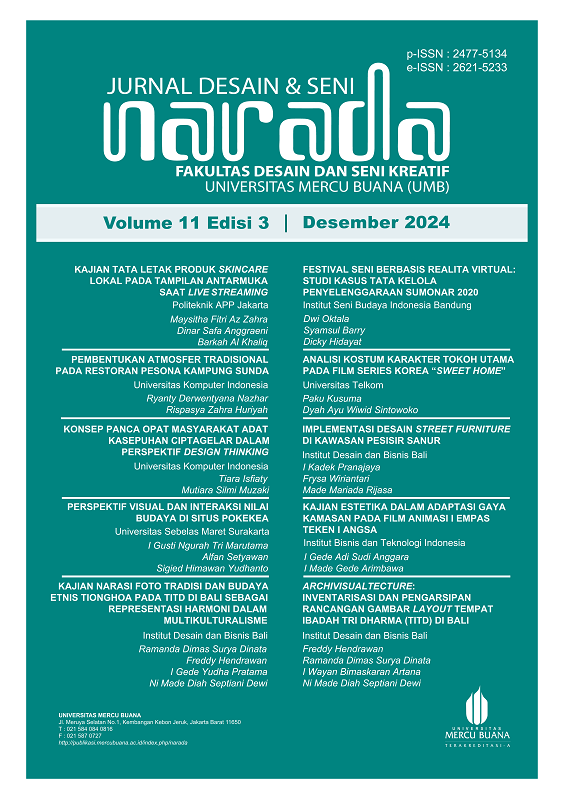
KONSEP PANCA OPAT MASYARAKAT ADAT KASEPUHAN CIPTAGELAR DALAM PERSPEKTIF DESIGN THINKING
DOI:
https://doi.org/10.22441/narada.2024/v11.i3.003Keywords:
Design thinking, Visual Culture, Kasepuhan Ciptagelar, Panca OpatAbstract
This study aims to identify the concept of Panca as an invention rooted in the indigenous Kasepuhan Ciptagelar community's local wisdom as a way to improve their lives while upholding the honorable principles of their customs. Innovation is a practice of human intelligence by utilizing technology to solve life problems from time to time. This fact is in line with design science as a problem solver in order to improve human life for the problems they face. Problem-solving activities in design can be studied using a design thinking approach. The cultural practices of the Kasepuhan Ciptagelar indigenous community are a form of innovation based on local wisdom that teaches us about overcoming problems that occur in the internal environment in a way that they create themselves. One of them is known as the Panca Opat concept. For the community, Panca Opat is a concept that is the basis for the customary order of their lives. The area of this research is the science of fine arts and design. This study uses a design thinking approach. The cultural practices of the Kasepuhan Ciptagelar indigenous community are a form of innovation based on local wisdom that teaches us about overcoming problems that occur in the internal environment in a way that they create themselves. One of them is known as the Panca Opat concept. For the community, Panca Opat is a concept that is the basis for the customary order of their lives. The area of this research is the science of fine arts and design. This research uses a design thinking approach. The stages analyzed are three stages, namely the stage of identifying problems (Empathize stage), the stage of solving problems based on the user's perspective (Define stage) and the stage of answering problems including the use of technology (Ideate stage). At the Empathize stage, the nature is to identify problems so that the research model that will be carried out is qualitative research. Qualitative methods refer to Moleong (1993), described as research that intends to understand the phenomenon of what is experienced by research subjects such as behavior, perception, motivation, actions holistically, and by means of description in the form of words and language. The results of the study are the findings of parako as a representation of the concept of panca opat. Parako is a crucial and constructive finding in the visual culture of the archipelago.
Downloads
References
Adimihardja, Kusnaka (1992). Kasepuhan Yang Tumbuh Di Atas Yang Luruh. Bandung : Penerbit Tarsito.
Aki Karma, (2015). Wawancara.
Chittick, William (2019) : The Antropocosmic Vision in Islamic.
Dillistone, F W. (2002). Daya Kekuatan Simbol The Power Of Symbols. Yogyakarta : Penerbit Kanisius.
Glen, R., Suciu, C., & Baughn, C. (2014). The Need for Design thinking in Business Schools. Academy of Management Learning & Education, 13(4), 653- 667. Diambil dari: https://www.jstor.org/stable/26621081
Hansen, S (2020). Investigasi Teknik Wawancara Dalam Penelitian Kualitatif Manajemen Konstruksi, Jurnal Teknik Sipil 27(3), 283-294.
DOI:https://doi.org/10.5614/jts.2020.27.3.10
Hidayat, A. (2018) Filsafat Berpikir Teknik Teknik Berpikir Logis Kontra Kesesatan Berpikir. Pamekasan: Duta Media Publishing.
Julianto, E.D & Hidayari, F (2018). Buku Metode Penelitian Praktis. Sidoarjo : Penerbit Zifatama Jawara.
Leavy, P (2017). Research Design - Quantitative, Qualitative, Mixed Methods, Arts-Based, and Community-Based Participatory Research Approaches. New York London : The Guilford Press.
Moleong, L J (1993). Metodologi penelitian kualitatif Edisi revisi. Bandung : Penerbit Remaja Rosdakarya.
Osann, I., Mayer, L., Wiele, I. (2020). The Design thinking Quick Start Guide: A 6-Step Process for Generating and Implementing Creative Solutions. United States: Wiley.
Rakhmat, M (2013). Pengantar Logika Dasar. Bandung : LoGoz Publishing.
Rosidi, A (2009): Manusia Sunda Sebuah Essai tentang Tokoh-Tokoh Satera dan Sejarah. Bandung : Penerbit Kiblat.
Seri Sundalana (2012) : Aspek Visual Budaya Sunda. Bandung : Penerbit Pusat Studi Sunda
Shanks, Michael (tanpa tahun). An Introduction to Design thinking Process Guide, PDF. Diambil dari: https://web.stanford.edu/~mshanks/MichaelShanks/files/509554.pdf diunduh pada 20 September 2022
Sumardjo, J. (2010).Estetika Paradoks. Bandung: Penerbit Sunan Ambu Press.
Thought. Diambil dari: http://www.williamcchittick.com/wp-content/uploads/2019/05/The- Anthropocosmic-Vision-in-Islamic-Thought.pdf diunduh pada tanggal 10 Maret 2019
Warnaen, S et. al, (1987). Pandangan Hidup Orang Sunda Seperti Tercermin Dalam Tradisi Lisan dan Sastra Sunda. Bandung : Departemen Pendidikan dan Kebudayaan-DIrektorat Jendral Kebudayaan-Bagian Proyek Penelitian dan Pengkajian Kebudayaan Sunda.
Zed, M (2004). Metode Penelitian Kepustakaan. Jakarta: Penerbit Yayasan Obor Indonesia.
Downloads
Published
How to Cite
Issue
Section
License
A writer who will publish their article in the NARADA Journal of Design and Art agrees to the following conditions:
- The author owns the copyright and grants the rights to NARADA Journal of Design and Art as the party entrusted with publishing the article for the first time simultaneously licensed under the "Creative Commons Attribution-ShareAlike 4.0" License. This makes it possible for other people to share the work with a form of acknowledgment of authorship of the work and initial publication in this journal according to the authorship of the article provided.
- Authors may enter into separate additional contractual agreements for non-exclusive distribution of the published journal version of the work (e.g., posting it to an institutional repository or publishing it in a book) with acknowledgment of initial publication in the NARADA Journal of Design and Art.
- Authors are permitted and asked to post their work online (for example, institutional repositories or on personal websites) after the article publication process. This avoids double publication or multiple submissions which will affect the similarity of writing of the published work.
- In order to maintain the value of originality and similarity of articles sent or submitted. Authors are asked to temporarily remove or hide the original article from other online systems until they receive the results and decisions from the NARADA Journal of Design and Art regarding the decision to publish the article.
- The author, in this case the contributing author (Contributor Author), will be sent a form or letter stating the validity of the scientific work, signed on an IDR 10,000 stamp. Then the author will be asked to send the email to [email protected].
Pemberitahuan Hak Cipta
Seorang penulis yang akan menerbitkan artikelnya dalam NARADA Jurnal Desain dan Seni setuju dengan ketentuan berikut:
- Penulis memiliki hak cipta dan memberikan hak kepada pihak NARADA Jurnal Desain dan Seni sebagai pihak yang diberikan kepercayaan untuk mempublikasi artikelnya pertama kali secara bersamaan dilisensikan di bawah Lisensi "Creative Commons Attribution-ShareAlike 4.0". Hal ini memungkinkan kepada orang lain untuk membagi karya dengan bentuk pengakuan kepengarangan karya dan publikasi awal dalam jurnal ini sesuai dengan penulisan artikel yang diberikan.
- Penulis dapat membuat perjanjian kontrak tambahan yang terpisah untuk distribusi non-eksklusif versi jurnal yang diterbitkan dari karya tersebut (misalnya, mempostingnya ke repositori institusional atau menerbitkannya dalam sebuah buku) dengan pengakuan publikasi awal dalam NARADA Jurnal Desain dan Seni.
- Penulis diizinkan dan diminta untuk mempostingkan karyanya secara online (semisal, repositori institusional atau di situs web pribadi) setelah proses penerbitan artikel, Hal ini menghindari adanya double publikasi atau pengajuan jamak yang akan berpengaruh kepada adanya kesamaan penulisan dari karya yang diterbitkan.
- Demi menjaga nilai orisinalitas dan nilai kesamaan dari artikel yang dikirim atau diajukan. Penulis diminta untuk menghilangkan atau menyembunyikan secara sementara artikel orisinil dari sistem online lain yang sampai mendapatkan hasil nilai dan ketetapan dari pihak NARADA Jurnal Desain dan Seni mengenai keputusan publikasi dari artikel.
- Penulis dalam hal ini penulis kontributor (Contributor Author) akan dikirimkan form atau surat pernyataan keabsahan karya ilmiah, yang ditanda tangani di atas materai 10000. Dan selanjutnya penulis diminta untuk mengirimkan ke email [email protected].









