
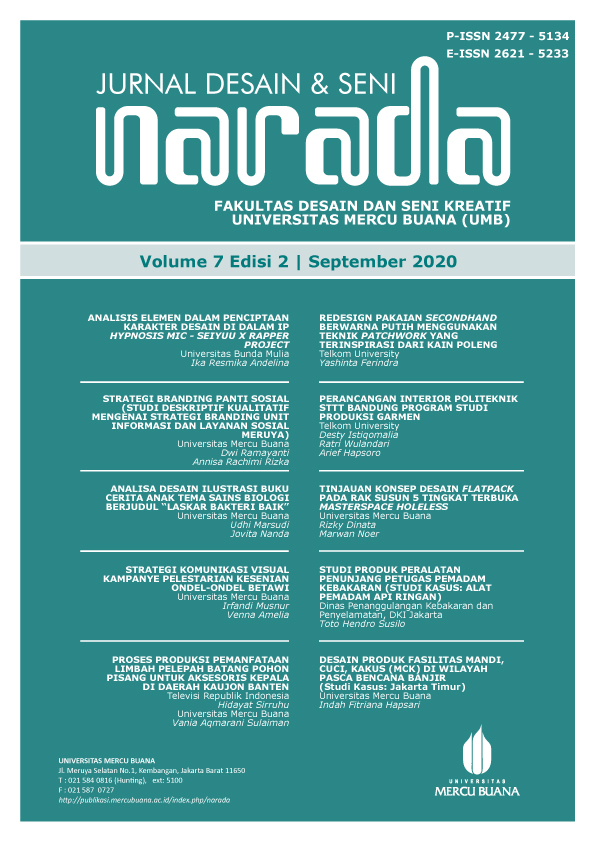
TINJAUAN KONSEP DESAIN FLATPACK PADA RAK SUSUN 5 TINGKAT TERBUKA MASTERSPACE HOLELESS
DOI:
https://doi.org/10.22441/narada.2020.v7.i2.008Keywords:
logistics efficiency, production efficiency, Flat-pack, furniture, knockdown, ready-toassembleAbstract
The success of developing new products is a prerequisite for companies to remain competitive in a market that is always demanding. The design concept with the term Flat-pack became very popular and inspired the design of other products, especially product design in small industries or artisans in Indonesia. Research on producing products that have successfully applied this design concept is very much needed to review and discuss the product details of the holeless level 5 Masterspace Rak as a product that will be a case study of how the design process and success in applying the Flat-pack design concept, with the basic principles of knockdown and RTA Ready theory To Assemble. The method that will be used to achieve the objectives of this research is the Basic Theory Method. In carrying out this method, it will be sought where phenomena can be said to be core phenomena that can be taken and formed into a theory. It is hoped that through this research, the results can be applied to the planning of craft innovative products by small craftsmen while still being able to compete globally.
Downloads
References
Artikel desain, Buku
Baer, D. (2016). Inside the Ikea design process - Business Insider. December 9, 2018, Diambil dari: https://www.businessinsider.com/inside-the-ikea-design-process-2016-1/?IR=T
Chi-Wing Fu, & Peng Song (2017). Reconfigurable Interlocking Furniture. Diambil dari: http://www.cse.cuhk.edu.hk/~cwfu/papers/reconfig/index.htm
Corbin, J., & Strauss, A. (2008). Basics of qualitative research: Techniques and procedures for developing grounded theory. California: SAGE Publiation.
Dahlborg, H., & Johnsson, C. (2006). Evaluating Packaging Logistics Development at IKEA for Improvements in Product and Packaging Development. Thesis: Lund University.
Fan, J. N., & Schodek, D. (2007). Personalized furniture within the condition of mass production. In The 9th international conference on ubiquitous computing (Ubicomp ‘07). Austria: Innsbruck.
Harris, R. Wen Shao Chang. Walker, P (2014). Engineering Research into Traditional Timber Joints. Diambil dari: https://researchportal.bath.ac.uk/en/publications/engineering-research-into-traditional-timber-joints
Hughes, P. (1996, January). Exporting furniture: Getting the packaging right. In. International Trade Forum, 1, 8. International Trade Centre.
Holman, W. (n.d.). Guerilla Furniture Design: How to Build Lean, Modern Furniture with Salvaged - Will Holman - Google Book. Diambil dari: https://books.google.co.id/books?id=1F3BBwAAQBAJ&printsec=frontcover&hl=id#v=onepage&q&f=false
Ikea. (2018). About/Democratic Design. December 9, 2018. Diambil dari: https://www.ikea.co.id/in/tentang/democratic-design/
Kong, S. C., Ogata, H., Arnseth, H. C., Chan, C. K. K., Hirashima, T., Klett, F., & Mitrovic, A. (2009). Constraint-based design critic for Flat-pack furniture design. In Proc. of the 17th International Conference on Computers in Education (pp. 19-26).
Moon, Y. (2004). IKEA invades America. Harvard Business School: USA.
Turner, troy. (2012). Flat-pack Elegance | Yanko Design. December 16, 2018, Diambil dari: https://www.yankodesign.com/2012/05/21/Flat-pack-elegance/
What is Flat-pack Furniture? Flat-pack Mates Explain it All! (2018). December 16, 2018, Diambil dari:
https://Flat-packmates.co.uk/blog/Flat-pack-furniture-explained/
Jurnal
Ainsworth, S., & VanLabeke, N. (2004). Multiple forms of dynamic representation. Learning and instruction, Volume 14(3), 241-255.
Burdurlu, E., Ciritcioglu, H. H., Bakir, K., & Ozdemir, M. (2006). Analysis of the most suitable fitting type for the assembly of knockdown panel furniture. Forest products journal, Volume 56(1), 46-53.
Chi-Wing Fu, & Peng Song. (2015). Computational Interlocking, Furniture Assembly, Volume 34(4), Article 91. Diperoleh dari link: http://cs.tau.ac.il
Egan, T. Marshall. (2002). Grounded Theory Research and Theory Building. Advances in Developing Human Resources, Volume 4(3).
Li, H., Guo, H., Skibniewski, M. J., & Skitmore, M. (2008). Using the IKEA model and virtual prototyping technology to improve construction process management. Construction Management and Economics. Construction Management and Economics, Volume 26(9):991-1000.
Löfgren, O. Design and Culture. Design by IKEA. A Cultural History. (2015). The Journal of the Design Studies Forum, Volume 7(3), 467-471. DOI: https://doi.org/10.1080/17547075.2015.1105510
Martin, Patricia Yancey and Barry A. Turner (1986). Grounded Theory and Organizational Research. The Journal of Applied Behavioral Science, Volume 22 (2).
Panghegar, A. F., & Pratama, D. (2017). Aplikasi Desain Flat-pack sebagai Upaya Efisiensi Produksi dan Logistik Studi Kasus: Bangku Bongkar Pasang KURIKKU. Simposium Nasional RAPI XVI – 2017 FT UMS, 39-47.
Puspita, A. A. P. A., Sachari, A., & Sriwarno, A. B. (2016). Dinamika Budaya Material pada Desain Furnitur Kayu di Indonesia. Panggung, Volume 26(3).
Ramadhan, A., & Sihombing, J. P. (2017). Kajian ergonomi desain sepeda fixed gear (fixie). PRODUCTUM Jurnal Desain Produk (Pengetahuan dan Perancangan Produk), Volume 3(1), 8-21.
Simek, M., & Sebera, V. (2010, October). Traditional furniture joinery from the point of view of advanced technologies. In Proceedings of the international convention of society of wood science and technology and United Nations economic commission for Europe—Timber Committee, Geneva, Switzerland (pp. 11-14).
Downloads
Published
How to Cite
Issue
Section
License
A writer who will publish their article in the NARADA Journal of Design and Art agrees to the following conditions:
- The author owns the copyright and grants the rights to NARADA Journal of Design and Art as the party entrusted with publishing the article for the first time simultaneously licensed under the "Creative Commons Attribution-ShareAlike 4.0" License. This makes it possible for other people to share the work with a form of acknowledgment of authorship of the work and initial publication in this journal according to the authorship of the article provided.
- Authors may enter into separate additional contractual agreements for non-exclusive distribution of the published journal version of the work (e.g., posting it to an institutional repository or publishing it in a book) with acknowledgment of initial publication in the NARADA Journal of Design and Art.
- Authors are permitted and asked to post their work online (for example, institutional repositories or on personal websites) after the article publication process. This avoids double publication or multiple submissions which will affect the similarity of writing of the published work.
- In order to maintain the value of originality and similarity of articles sent or submitted. Authors are asked to temporarily remove or hide the original article from other online systems until they receive the results and decisions from the NARADA Journal of Design and Art regarding the decision to publish the article.
- The author, in this case the contributing author (Contributor Author), will be sent a form or letter stating the validity of the scientific work, signed on an IDR 10,000 stamp. Then the author will be asked to send the email to [email protected].
Pemberitahuan Hak Cipta
Seorang penulis yang akan menerbitkan artikelnya dalam NARADA Jurnal Desain dan Seni setuju dengan ketentuan berikut:
- Penulis memiliki hak cipta dan memberikan hak kepada pihak NARADA Jurnal Desain dan Seni sebagai pihak yang diberikan kepercayaan untuk mempublikasi artikelnya pertama kali secara bersamaan dilisensikan di bawah Lisensi "Creative Commons Attribution-ShareAlike 4.0". Hal ini memungkinkan kepada orang lain untuk membagi karya dengan bentuk pengakuan kepengarangan karya dan publikasi awal dalam jurnal ini sesuai dengan penulisan artikel yang diberikan.
- Penulis dapat membuat perjanjian kontrak tambahan yang terpisah untuk distribusi non-eksklusif versi jurnal yang diterbitkan dari karya tersebut (misalnya, mempostingnya ke repositori institusional atau menerbitkannya dalam sebuah buku) dengan pengakuan publikasi awal dalam NARADA Jurnal Desain dan Seni.
- Penulis diizinkan dan diminta untuk mempostingkan karyanya secara online (semisal, repositori institusional atau di situs web pribadi) setelah proses penerbitan artikel, Hal ini menghindari adanya double publikasi atau pengajuan jamak yang akan berpengaruh kepada adanya kesamaan penulisan dari karya yang diterbitkan.
- Demi menjaga nilai orisinalitas dan nilai kesamaan dari artikel yang dikirim atau diajukan. Penulis diminta untuk menghilangkan atau menyembunyikan secara sementara artikel orisinil dari sistem online lain yang sampai mendapatkan hasil nilai dan ketetapan dari pihak NARADA Jurnal Desain dan Seni mengenai keputusan publikasi dari artikel.
- Penulis dalam hal ini penulis kontributor (Contributor Author) akan dikirimkan form atau surat pernyataan keabsahan karya ilmiah, yang ditanda tangani di atas materai 10000. Dan selanjutnya penulis diminta untuk mengirimkan ke email [email protected].









