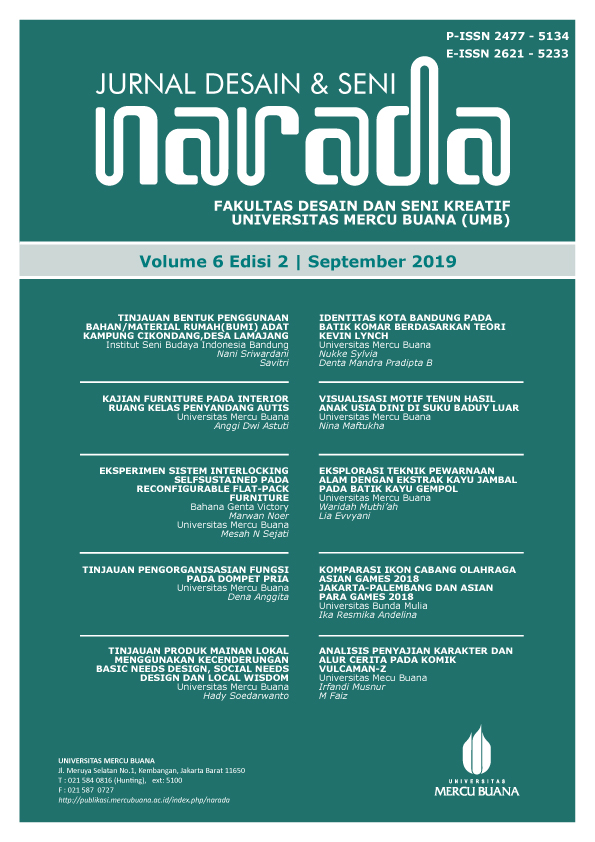
IDENTITAS KOTA BANDUNG PADA BATIK KOMAR BERDASARKAN TEORI KEVIN LYNCH
DOI:
https://doi.org/10.22441/narada.2019.v6.i2.006Keywords:
Identitas kota bandung, Batik Komar, kota BandungAbstract
Identity is a characteristic or to the repertoire of a place, which makes someone recall and wants to visit again where they are intended because it has differences with other places because it has character and uniqueness. Identity is a very important fundamental thing. This is because identity is something that is used to recognize, distinguish a place from another place Kevin Lynch, good city form (1984; 131). According to RI Minister of Home Affairs regulation No. 4 years old 1980, the City is a place that has administrative boundaries such as municipalities and administrative cities. The city also means an urban living environment that has non-agrarian characteristics, for example, the district capital, the capital of the sub-district which functions as the center of growth. One that has these characteristics is the city of Bandung, the city of Bandung is one place that has its own uniqueness and character, both in places of tourism, food, and other foods. One of the places visited by many local and foreign tourists in searching for souvenirs or souvenirs is Batik. One of the famous Batik venues in Bandung is Komar Batik, Batik Komar is one place that produces Batik with Bandung City motif. Therefore the author wants to examine the Bandung City motif made by Batik Komar with the theory of Kevin Linch so that the history of the Bandung Batik can be maintained. After producing the Bandung Batik analysis, it can be concluded that Batik Komar as a batik maker reflects the identity of Bandung City.
Downloads
References
Achjadi. (1999). Judy : Batik Spirit Of Indonesia. Indonesia: Yayasan Batik Indonesia.
Anas. Biranul, Hasanudin, Pangabean. Ratna, Sunarya. Yanya: “Indonesia Indah”: Latar belakang kehidupan bangsa Indonesia Adat istiadat dan seni budaya. Yayasan Harapan Kita. ISBN no. 979-8735-07-2
Rosidi, A., dkk. (2000). Ensiklopedi Sunda. Jakarta: Pustaka Jaya.
Bodgan R&S. J Taylor : Kulitatif Dasar-Dasar Penelitian (Terjemahan Roni Sianturi ) Surabaya: Usaha Nasional, 1993.
Bambang As. Suroyo Irawati: “ISEN-ISEN”:The Passion of Tati Suroyo, Pt. Ciriajasa Rancang Bangun. ISBN 978-602-18443-0-4.
Budiman, K. (2005). Ikonisitas: Semiotika Sastra Dan Seni Visual. Yogyakarta: Buku Baik.
Judith N. Martin, Thomas K. Nakayama: “Intercultural Communication in Contexts”, McGraw Hill, 2009. p. 180-92. ISBN 978 - 0-07-338512-9.
James D. Fearon. "What is Identity (As We Know Use The Word)" (PDF). Diakses tanggal 7 Mei 2014.
Kudiya, Komarudin. Djatmiko, Djalu. Jusuf Herman. Rais, Zini., Ken Atik, Syaftiyaningsih: “Batik Pesisir Selatan Jawa Barat”, Yogyakarta,2014. ISBN:978-602-7949-18-8.
Kudiya, K. (2011). Batik, eksistensi untuk Tradisi. Yogyakarta: DianRakyat. ISBN:978-979-078-355-3.
Kusrianto, Adi. BATIK , filosofi, motif dan kegunaan. Yogyakarta :ANDI , 12013. ISBN :978-979-29-4062-6.
Larry A. Samovar, Richard E. Porter, Edwin McDaniel. (2009). Communication Between Cultures.
Lynch, K. (1960). The Image of The City. Cambridge: MIT Press.
Lynch, K. (1972). Good City Form. Cambridge: MIT Press.
Maleong, L.J. (1993). Metodologi Penelitian Kualitatif. Bandung: PT. Remaja Rosdakarya.
Rizali, N. (2014). Nafas Islami Dalam Batik Nusantara. Surakarta: UNS Press.
Nadia Nava, Il batik – Ulissedizioni-1991 ISBN 88-414-1016-7
PAD Jawa Barat : “Indonesia's Population”: Ethnicity and Religion in a Changing Political Landscape, Institute of Southeast Asian Studies, 2003.
Steinmann, A: THE ART OF BATIK, Ciba Review, #58, Juli 1947, pp.2090-2101.
Sobur, A. (2003). Semiotika Komunikasi. Bandung: Rosda.
Trijoto, Suprihatin, Mujiasih. (2010). MENGENALDAN MEMBUATMOTIF BATIK Menggali Sumber Inspirasi Pembuatan Motif Batik. Gama Media. ISBN: 978-979-1104-48-7.
Veldhuisen. Hermen C. (1993). BATIK BELANDA 1840 – 1940. Ducth influence in batik, Gaya Favorit Press.
Downloads
Published
How to Cite
Issue
Section
License
A writer who will publish their article in the NARADA Journal of Design and Art agrees to the following conditions:
- The author owns the copyright and grants the rights to NARADA Journal of Design and Art as the party entrusted with publishing the article for the first time simultaneously licensed under the "Creative Commons Attribution-ShareAlike 4.0" License. This makes it possible for other people to share the work with a form of acknowledgment of authorship of the work and initial publication in this journal according to the authorship of the article provided.
- Authors may enter into separate additional contractual agreements for non-exclusive distribution of the published journal version of the work (e.g., posting it to an institutional repository or publishing it in a book) with acknowledgment of initial publication in the NARADA Journal of Design and Art.
- Authors are permitted and asked to post their work online (for example, institutional repositories or on personal websites) after the article publication process. This avoids double publication or multiple submissions which will affect the similarity of writing of the published work.
- In order to maintain the value of originality and similarity of articles sent or submitted. Authors are asked to temporarily remove or hide the original article from other online systems until they receive the results and decisions from the NARADA Journal of Design and Art regarding the decision to publish the article.
- The author, in this case the contributing author (Contributor Author), will be sent a form or letter stating the validity of the scientific work, signed on an IDR 10,000 stamp. Then the author will be asked to send the email to [email protected].
Pemberitahuan Hak Cipta
Seorang penulis yang akan menerbitkan artikelnya dalam NARADA Jurnal Desain dan Seni setuju dengan ketentuan berikut:
- Penulis memiliki hak cipta dan memberikan hak kepada pihak NARADA Jurnal Desain dan Seni sebagai pihak yang diberikan kepercayaan untuk mempublikasi artikelnya pertama kali secara bersamaan dilisensikan di bawah Lisensi "Creative Commons Attribution-ShareAlike 4.0". Hal ini memungkinkan kepada orang lain untuk membagi karya dengan bentuk pengakuan kepengarangan karya dan publikasi awal dalam jurnal ini sesuai dengan penulisan artikel yang diberikan.
- Penulis dapat membuat perjanjian kontrak tambahan yang terpisah untuk distribusi non-eksklusif versi jurnal yang diterbitkan dari karya tersebut (misalnya, mempostingnya ke repositori institusional atau menerbitkannya dalam sebuah buku) dengan pengakuan publikasi awal dalam NARADA Jurnal Desain dan Seni.
- Penulis diizinkan dan diminta untuk mempostingkan karyanya secara online (semisal, repositori institusional atau di situs web pribadi) setelah proses penerbitan artikel, Hal ini menghindari adanya double publikasi atau pengajuan jamak yang akan berpengaruh kepada adanya kesamaan penulisan dari karya yang diterbitkan.
- Demi menjaga nilai orisinalitas dan nilai kesamaan dari artikel yang dikirim atau diajukan. Penulis diminta untuk menghilangkan atau menyembunyikan secara sementara artikel orisinil dari sistem online lain yang sampai mendapatkan hasil nilai dan ketetapan dari pihak NARADA Jurnal Desain dan Seni mengenai keputusan publikasi dari artikel.
- Penulis dalam hal ini penulis kontributor (Contributor Author) akan dikirimkan form atau surat pernyataan keabsahan karya ilmiah, yang ditanda tangani di atas materai 10000. Dan selanjutnya penulis diminta untuk mengirimkan ke email [email protected].









