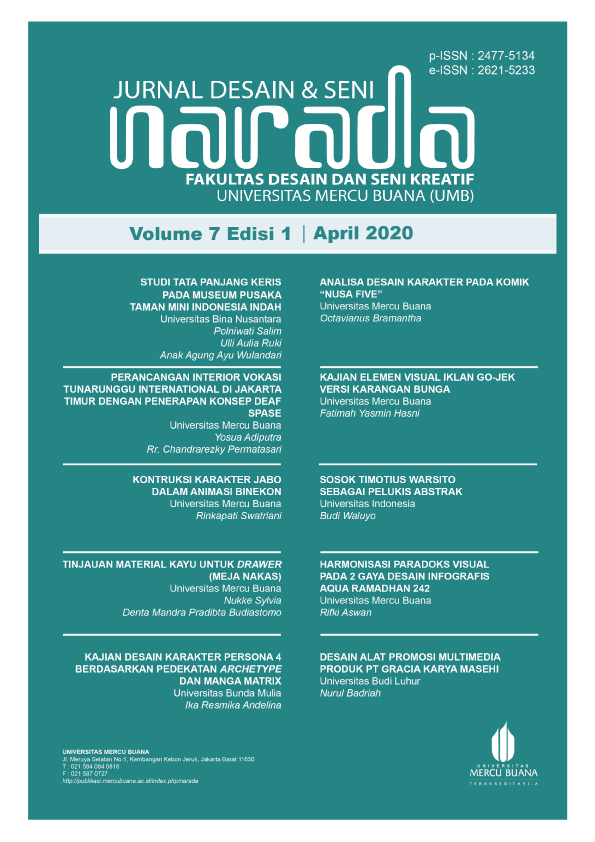
PERANCANGAN INTERIOR VOKASI TUNARUNGU INTERNASIONAL DI JAKARTA TIMUR DENGAN PENERAPAN KONSEP DESAIN DEAF SPACE
Keywords:
Design, Vocational Education, Deaf, Deaf Space, Modern, and Visual ConnectingAbstract
Vocational education is education that directs students to develop applied expertise and skills that can adapt to certain occupations and can create jobs. Vocational education aims to prepare a skilled workforce ready for work that is expected to meet employment needs. There are still limited opportunities for deaf students to continue their higher studies, this is because in Indonesia there is not yet a special applied education for deaf study in the field of arts education.
So that deaf space special vocational education must be applied based on the deaf space design principles so that interior elements can support and apply in accordance with the principle of deaf space to be easier in accessibility and disability friendly.
Thus the idea that was raised in the interior design of VTI was to provide children with hearing impairment to learn well and be pleasant. The concept of "Modern and Visual Connecting" is a concept that presents a spatial atmosphere in the form of visual connecting characteristics that are given a modern impression.
This is expected to become a better VTI and invite people with special needs to continue VTI schooling to become smarter children.
Downloads
References
Chiambretto, A., dan Trillingsgaard, A. K. (2016). Deaf Space Individuality + Integration An extension of Gallaudet University, Washington D.C, USA. Issuu. Diambil dari: https://issuu.com/astatrillingsgaard/docs/deafspace_-_individuality___integra
Viantoro, G. I. (2012, Mei). Sekolah Bertaraf Internasional. Lecture. Diambil dari: https://ganieindraviantoro.wordpress.com/kuliah/semester-4/education-management/sekolah-bertaraf-internasional/
LPMP Sumsel, Workshop sekolah bertaraf internasional
Permen PUPR No. 14/PRT/M/2017 tentang Persyaratan Kemudahan Bangunan Gedung.
Downloads
Additional Files
Published
How to Cite
Issue
Section
License
A writer who will publish their article in the NARADA Journal of Design and Art agrees to the following conditions:
- The author owns the copyright and grants the rights to NARADA Journal of Design and Art as the party entrusted with publishing the article for the first time simultaneously licensed under the "Creative Commons Attribution-ShareAlike 4.0" License. This makes it possible for other people to share the work with a form of acknowledgment of authorship of the work and initial publication in this journal according to the authorship of the article provided.
- Authors may enter into separate additional contractual agreements for non-exclusive distribution of the published journal version of the work (e.g., posting it to an institutional repository or publishing it in a book) with acknowledgment of initial publication in the NARADA Journal of Design and Art.
- Authors are permitted and asked to post their work online (for example, institutional repositories or on personal websites) after the article publication process. This avoids double publication or multiple submissions which will affect the similarity of writing of the published work.
- In order to maintain the value of originality and similarity of articles sent or submitted. Authors are asked to temporarily remove or hide the original article from other online systems until they receive the results and decisions from the NARADA Journal of Design and Art regarding the decision to publish the article.
- The author, in this case the contributing author (Contributor Author), will be sent a form or letter stating the validity of the scientific work, signed on an IDR 10,000 stamp. Then the author will be asked to send the email to [email protected].
Pemberitahuan Hak Cipta
Seorang penulis yang akan menerbitkan artikelnya dalam NARADA Jurnal Desain dan Seni setuju dengan ketentuan berikut:
- Penulis memiliki hak cipta dan memberikan hak kepada pihak NARADA Jurnal Desain dan Seni sebagai pihak yang diberikan kepercayaan untuk mempublikasi artikelnya pertama kali secara bersamaan dilisensikan di bawah Lisensi "Creative Commons Attribution-ShareAlike 4.0". Hal ini memungkinkan kepada orang lain untuk membagi karya dengan bentuk pengakuan kepengarangan karya dan publikasi awal dalam jurnal ini sesuai dengan penulisan artikel yang diberikan.
- Penulis dapat membuat perjanjian kontrak tambahan yang terpisah untuk distribusi non-eksklusif versi jurnal yang diterbitkan dari karya tersebut (misalnya, mempostingnya ke repositori institusional atau menerbitkannya dalam sebuah buku) dengan pengakuan publikasi awal dalam NARADA Jurnal Desain dan Seni.
- Penulis diizinkan dan diminta untuk mempostingkan karyanya secara online (semisal, repositori institusional atau di situs web pribadi) setelah proses penerbitan artikel, Hal ini menghindari adanya double publikasi atau pengajuan jamak yang akan berpengaruh kepada adanya kesamaan penulisan dari karya yang diterbitkan.
- Demi menjaga nilai orisinalitas dan nilai kesamaan dari artikel yang dikirim atau diajukan. Penulis diminta untuk menghilangkan atau menyembunyikan secara sementara artikel orisinil dari sistem online lain yang sampai mendapatkan hasil nilai dan ketetapan dari pihak NARADA Jurnal Desain dan Seni mengenai keputusan publikasi dari artikel.
- Penulis dalam hal ini penulis kontributor (Contributor Author) akan dikirimkan form atau surat pernyataan keabsahan karya ilmiah, yang ditanda tangani di atas materai 10000. Dan selanjutnya penulis diminta untuk mengirimkan ke email [email protected].





