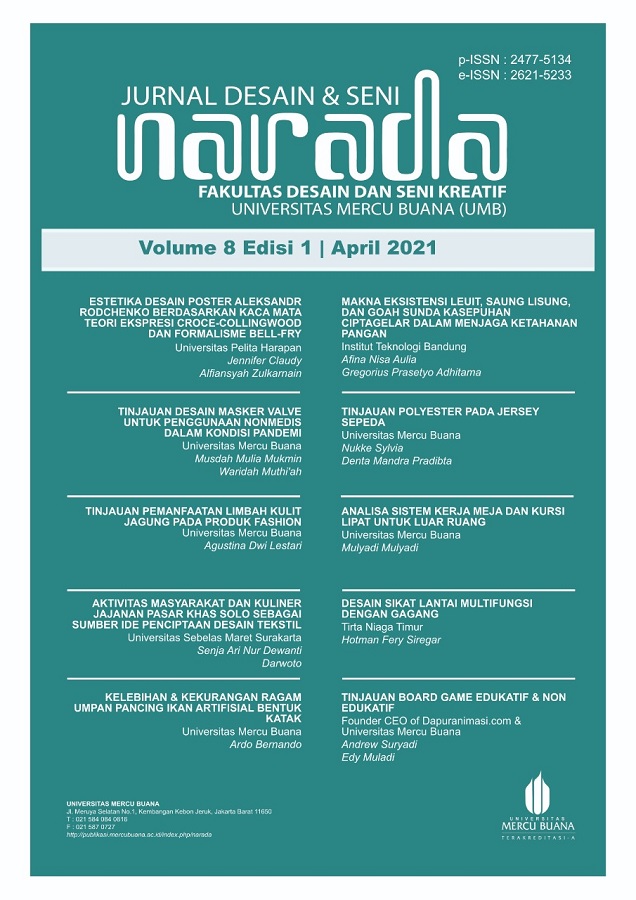
AKTIVITAS MASYARAKAT DAN KULINER JAJANAN PASAR KHAS SOLO SEBAGAI SUMBER IDE PENCIPTAAN DESAIN TEKSTIL
DOI:
https://doi.org/10.22441/narada.2021.v8.i1.004Keywords:
Jajan Pasar Typical of Solo, Tekstile Design, Digital Printing, Promotion MediaAbstract
The background of designing this product is to create innovation in visual textile design, especially for surface design with traditional Solo traditional food visuals (Jajan pasar) which is contained in the atmosphere where the food is located with the intention of conveying a message so that the millennial generation knows more and wants to preserve something traditional. , and it can be started from the most common thing, namely getting to know traditional food from Solo. This work will later explore the form of traditional food, especially Solo traditional snacks and the atmosphere where the food is located which will be visualized into designs on the textile surface. This work comes because of the problem of traditional food which is now being displaced by external foods such as junk food, fast food, and western food. Apart from that, the modernization style of the teenagers is arguably westernized which also affects their diet in their daily interactions. In order to support their existence and match the lifestyle of other friends. The results of this design can be concluded into a number of things: (1) exploring the visual form of digital design with the source of the idea of "Typical Solo Market Jajanan Pasar" with illustrative styling with food visuals that resemble its original form in which a selling and buying story is written, as well as placing objects food itself into people's daily lives. (2) The design is intended for media promotion of typical Solo food to adolescents. (3) The design is realized with digital printing techniques which will later be transformed into unisex clothing for ages 17-25 years (late teens). In addition, this product is expected to convey a message and can be a special attraction for millennial generation children to preserve and love something traditional, as well as a new style campaign in maintaining the existence of something that is traditional and is one of the cultures, namely by making this product. as a souvenir which will later be processed into clothing products favored by millennial children.
Downloads
References
Amaliah N, dkk. (2015). Perancangan Media Promosi PT Petronika Sebagai Upaya Pembentukan Citra Perusahaan. Jurnal Desain Komunikasi Visual, Vol.4, No.1.
Basri, H. (1995). Remaja Berkualitas. Yogyakarta: Pustaka Pelajar.
Candra, R. (2010). “Landasan Konseptual Perencanaan Dan Perancangan Pusat Kuliner Khas Solo Di Solo”. [Tugas Akhir]. Yogyakarta: Program Studi Arsitektur Fakultas Teknik Universitas Atma Jaya Yogyakarta.
Dara, M. (2018). Pengolahan Motif Pada Buya Bomba Dengan Teknik Digital Printing. Jurnal ATRAT, 6(01), 13-24.
Fadilah, N. R., & Endang, A. (2018). Perbedaan Hasil Jadi Motif Dengan Teknik Direct To Garment Print Pada T- Shirt Cotton Combed Dan Cotton Carded. Jurnal Tata Busana,07(02), 71-75.
Hendariningrum, R. & Susilo, M. E. (2008). Fashion Dan Gaya Hidup: Identitas Dan Komunikasi, Jurnal Ilmu Komunikasi, 6(2), 25-3.
Mubarat, H & Iswandi. H. (2018). Pelatihan Sablon Dalam Upaya Meningkatkan Keterampilan Siswa/I Jurusan Multimedia Smk Muhammadiyah 2 Palembang. Jurnal Abdimas Mandiri,2(2), 74-83.
DOI:http://dx.doi.org/10.36982/jam.v2i2.527
Mulyadi,dkk. (2018). Pkm Peningkatan Produktivitas Bisnis Sablon Di Jawa Timur. Jurnal Dedikasi,15, 15-19.
Muqorobin, dkk. (2014). “Perancangan Media Promosi dan Informasi Berbasis Multimedia Interaktif Pada CV Karunia Semarang”. [Skripsi]. Semarang: Program Studi Komputer Grafis STEKOM Semarang.
Panjaitan, N,dkk. (2017). Reduksi Produk Cacat Pada Kegiatan Pencetakan. Jurnal Ilmiah Widya Teknik, 16(2), 85-90.
DOI:https://doi.org/10.33508/wt.v16i2.1661
Rizali, N. (2012). Metode Perancangan Tekstil. Surakarta: UNS Press.
Rizali, N 2017. Tinjauan DesainTekstil. Surakarta: UNS Press
Sintia, D. (2017). Eksplorasi Teknik Sablon Pada Produk Ready To Wear Dengan Inspirasi Lukisan Jackson Pollock. e-Proceeding of Art & Design,4(3), 888-904.
Trisnawati, T. Y. (2011). Fashion sebagai Bentuk Ekspresi Diri dalam Komunikasi. The Messenger, 3 (1), 36-47.
Downloads
Published
How to Cite
Issue
Section
License
A writer who will publish their article in the NARADA Journal of Design and Art agrees to the following conditions:
- The author owns the copyright and grants the rights to NARADA Journal of Design and Art as the party entrusted with publishing the article for the first time simultaneously licensed under the "Creative Commons Attribution-ShareAlike 4.0" License. This makes it possible for other people to share the work with a form of acknowledgment of authorship of the work and initial publication in this journal according to the authorship of the article provided.
- Authors may enter into separate additional contractual agreements for non-exclusive distribution of the published journal version of the work (e.g., posting it to an institutional repository or publishing it in a book) with acknowledgment of initial publication in the NARADA Journal of Design and Art.
- Authors are permitted and asked to post their work online (for example, institutional repositories or on personal websites) after the article publication process. This avoids double publication or multiple submissions which will affect the similarity of writing of the published work.
- In order to maintain the value of originality and similarity of articles sent or submitted. Authors are asked to temporarily remove or hide the original article from other online systems until they receive the results and decisions from the NARADA Journal of Design and Art regarding the decision to publish the article.
- The author, in this case the contributing author (Contributor Author), will be sent a form or letter stating the validity of the scientific work, signed on an IDR 10,000 stamp. Then the author will be asked to send the email to [email protected].
Pemberitahuan Hak Cipta
Seorang penulis yang akan menerbitkan artikelnya dalam NARADA Jurnal Desain dan Seni setuju dengan ketentuan berikut:
- Penulis memiliki hak cipta dan memberikan hak kepada pihak NARADA Jurnal Desain dan Seni sebagai pihak yang diberikan kepercayaan untuk mempublikasi artikelnya pertama kali secara bersamaan dilisensikan di bawah Lisensi "Creative Commons Attribution-ShareAlike 4.0". Hal ini memungkinkan kepada orang lain untuk membagi karya dengan bentuk pengakuan kepengarangan karya dan publikasi awal dalam jurnal ini sesuai dengan penulisan artikel yang diberikan.
- Penulis dapat membuat perjanjian kontrak tambahan yang terpisah untuk distribusi non-eksklusif versi jurnal yang diterbitkan dari karya tersebut (misalnya, mempostingnya ke repositori institusional atau menerbitkannya dalam sebuah buku) dengan pengakuan publikasi awal dalam NARADA Jurnal Desain dan Seni.
- Penulis diizinkan dan diminta untuk mempostingkan karyanya secara online (semisal, repositori institusional atau di situs web pribadi) setelah proses penerbitan artikel, Hal ini menghindari adanya double publikasi atau pengajuan jamak yang akan berpengaruh kepada adanya kesamaan penulisan dari karya yang diterbitkan.
- Demi menjaga nilai orisinalitas dan nilai kesamaan dari artikel yang dikirim atau diajukan. Penulis diminta untuk menghilangkan atau menyembunyikan secara sementara artikel orisinil dari sistem online lain yang sampai mendapatkan hasil nilai dan ketetapan dari pihak NARADA Jurnal Desain dan Seni mengenai keputusan publikasi dari artikel.
- Penulis dalam hal ini penulis kontributor (Contributor Author) akan dikirimkan form atau surat pernyataan keabsahan karya ilmiah, yang ditanda tangani di atas materai 10000. Dan selanjutnya penulis diminta untuk mengirimkan ke email [email protected].









