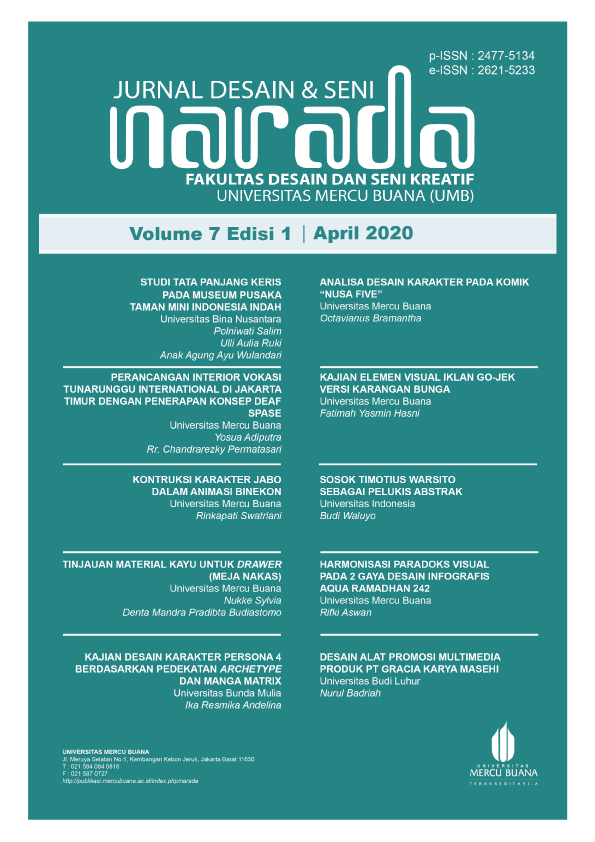
KAJIAN DESAIN KARAKTER PERSONA 4 BERDASARKAN PENDEKATAN ARCHETYPE DAN MANGA MATRIX
DOI:
https://doi.org/10.22441/narada.2020.v7.i1.005Keywords:
Character Design, Archetype, Carl Jung, Persona 4, Manga MatrixAbstract
Games are often used as an entertainment medium that occupies a place in the hearts of consumers. One type of game that still has a high interest in console games. Persona 4 is a Playstation game that was released on July 10, 2008, and won the Game of the Year title from many game criticism and media review games. Persona 4 was praised for its unique visual style, interesting and powerful stories, and the bold adoption of social themes and gender sexuality. The visual aspect of Persona that will be analyzed in this research is related to the creation and design of characters in intellectual property. This research will be examined in terms of overall character design, using Carl Jung's Archetype approach to dissect personality characterization, then its relation to visual using Hiroyoshi Tsukamoto's Manga Matrix approach and then deepened by using intertextual theory to dissect conceptually, as well as what aspects influence the character's creation. So it is hoped that the results of this study can be a reference material for developing character design created in the world of learning and also industry, especially in the gaming industry, to create fantasy characters that have an appeal in attracting players.
Downloads
References
Allen, Graham. 2000. Intertextuality. London and New York. Routledge.
ATLUS. 2008. P4 Official Works. ATLUS Japan.
Eko H, M.Natsir, Singgih D K. 2019. An Analysis of Smeagol's Character Influenced by The One Ring In Lord of The Rings: Return of The King Using Jung Archetypes. Jurnal Ilmu Budaya Vol. 3, No. 1, Januari 2019, pp 106-120.
Harbunangin, Buntje. 2016. Art & Jung:Seni Dalam Sorotan Psikologi Analitis Jung.
Kusrianto, Adi. 2007. Pengantar Desain Komunikasi Visual. Yogyakarta: Penerbit Andi.
M. Garry Saputra. 2019. “Desain Karakter Dalam Serial Shonen Manga One Punch Man”. Sekolah Pascasarjana. Institut Kesenian Jakarta. Jakarta.
Sugiyono. 2014. Metode Penelitian Kuantitatif Kualitatif dan R&D. Bandung : Alfabeta.
Tilman, Bryan. 2011. Creative Character Design. USA. Focal Press.
Tsukamoto, H. 2006. Manga Matrix: Create Unique Characters Using the Japanese Matrix System, USA: Collins Design.
Downloads
Published
How to Cite
Issue
Section
License
A writer who will publish their article in the NARADA Journal of Design and Art agrees to the following conditions:
- The author owns the copyright and grants the rights to NARADA Journal of Design and Art as the party entrusted with publishing the article for the first time simultaneously licensed under the "Creative Commons Attribution-ShareAlike 4.0" License. This makes it possible for other people to share the work with a form of acknowledgment of authorship of the work and initial publication in this journal according to the authorship of the article provided.
- Authors may enter into separate additional contractual agreements for non-exclusive distribution of the published journal version of the work (e.g., posting it to an institutional repository or publishing it in a book) with acknowledgment of initial publication in the NARADA Journal of Design and Art.
- Authors are permitted and asked to post their work online (for example, institutional repositories or on personal websites) after the article publication process. This avoids double publication or multiple submissions which will affect the similarity of writing of the published work.
- In order to maintain the value of originality and similarity of articles sent or submitted. Authors are asked to temporarily remove or hide the original article from other online systems until they receive the results and decisions from the NARADA Journal of Design and Art regarding the decision to publish the article.
- The author, in this case the contributing author (Contributor Author), will be sent a form or letter stating the validity of the scientific work, signed on an IDR 10,000 stamp. Then the author will be asked to send the email to [email protected].
Pemberitahuan Hak Cipta
Seorang penulis yang akan menerbitkan artikelnya dalam NARADA Jurnal Desain dan Seni setuju dengan ketentuan berikut:
- Penulis memiliki hak cipta dan memberikan hak kepada pihak NARADA Jurnal Desain dan Seni sebagai pihak yang diberikan kepercayaan untuk mempublikasi artikelnya pertama kali secara bersamaan dilisensikan di bawah Lisensi "Creative Commons Attribution-ShareAlike 4.0". Hal ini memungkinkan kepada orang lain untuk membagi karya dengan bentuk pengakuan kepengarangan karya dan publikasi awal dalam jurnal ini sesuai dengan penulisan artikel yang diberikan.
- Penulis dapat membuat perjanjian kontrak tambahan yang terpisah untuk distribusi non-eksklusif versi jurnal yang diterbitkan dari karya tersebut (misalnya, mempostingnya ke repositori institusional atau menerbitkannya dalam sebuah buku) dengan pengakuan publikasi awal dalam NARADA Jurnal Desain dan Seni.
- Penulis diizinkan dan diminta untuk mempostingkan karyanya secara online (semisal, repositori institusional atau di situs web pribadi) setelah proses penerbitan artikel, Hal ini menghindari adanya double publikasi atau pengajuan jamak yang akan berpengaruh kepada adanya kesamaan penulisan dari karya yang diterbitkan.
- Demi menjaga nilai orisinalitas dan nilai kesamaan dari artikel yang dikirim atau diajukan. Penulis diminta untuk menghilangkan atau menyembunyikan secara sementara artikel orisinil dari sistem online lain yang sampai mendapatkan hasil nilai dan ketetapan dari pihak NARADA Jurnal Desain dan Seni mengenai keputusan publikasi dari artikel.
- Penulis dalam hal ini penulis kontributor (Contributor Author) akan dikirimkan form atau surat pernyataan keabsahan karya ilmiah, yang ditanda tangani di atas materai 10000. Dan selanjutnya penulis diminta untuk mengirimkan ke email [email protected].









