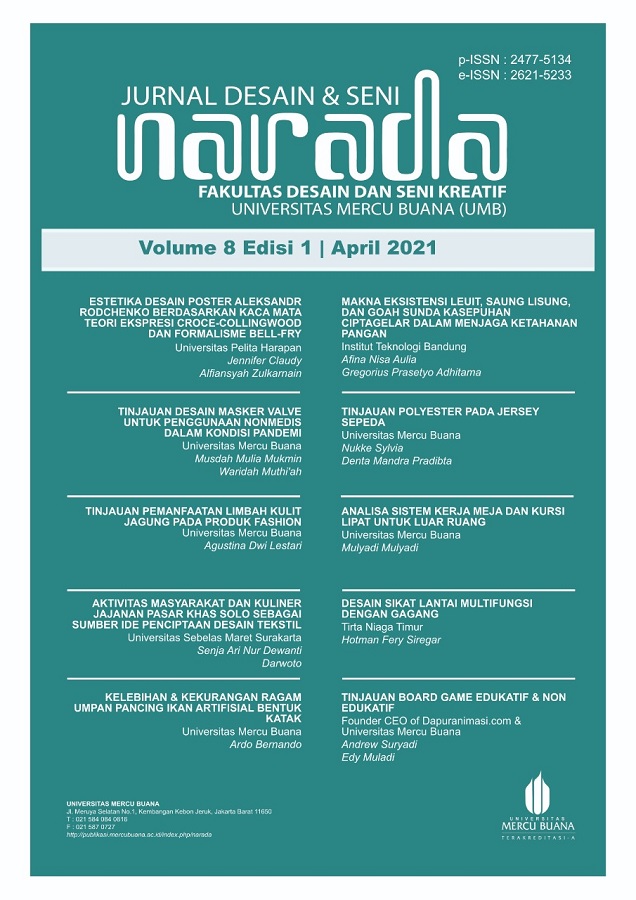
DESAIN SIKAT LANTAI MULTIFUNGSI DENGAN GAGANG
DOI:
https://doi.org/10.22441/narada.2021.v8.i1.009Keywords:
Design, floor, brush, multifunctionAbstract
The floor brush is one of the hygiene products that are still a mainstay for cleaning floors, bathroom walls and other hard surfaces. Floor brushes in its use still not fully pay attention to aspects of user needs, such as user convenience and functionality. The use of floor brushes is mostly done in an abnormal work position, such as brushing the floor with a squatting position or with a bent position. With method starting from the stage of extracting ideas, the analysis continues with the development stage, design concepts, systems and details, prototyping, production processes, product evaluation or testing, ending with the distribution stage. Evaluation also needs to use certain benchmarks, to find out how far a design has met the technical, functional, aesthetic and economic quality. Cleaning activities are needed for a certain period to maintain the area where the activity becomes more comfortable. Bathroom or toilet is the most crucial room for a dwelling. Required hygiene tool that has more functionality than just brush the floor (multifunction), and also compact, so it can do efficient use of equipment cleanliness and ease in use.
Downloads
References
Arisza, D. (2013). Interior Rumah Mungil. Jakarta; Griya Kreasi.
Astuti D, A. (2018). Penerapan Warna Pada Ruang Interior Anak Autis. Narada Jurnal Desain Dan Seni, 5(1).
Mardalis. (1999), Metode Penelitian Suatu Pendekatan Proposal. Bumi Aksara: Jakarta.
Nurmianto, E. (1998). Ergonomi Konsep Dasar Dan Aplikasinya, Surabaya: Pt Guna Widya.
Surdia, T & Saito, S. (1992). Pengetahuan Bahan Teknik, Pt. Pradnya Paramita, Jakarta.
Panero, J & Zelnik, M. (2003). Dimensi Manusia Dan Ruang Interior. Jakarta: Erlangga.
Pheasant, S. (1996). Body Space: Anthropometry, Ergonomics And Design, London: Taylor And Francis.
Rahmatia, A & Nurahmartiyanti, S. (2009). Menata Furniture Rumah Minimalis. Jakarta; Griya Kreasi.
Ramadhan, A & Mulia, F. (2017). Studi Ergonomi Produk Gayung. Jakarta Universitas Mercu Buana. Https://Www.Researchgate.Net/Profile/Ali_Ramadhan5/Publication/321873773_Studi_Ergonomi_Produk_Gayung/Links/5a373653a6fdcc769fd7c3ce/Studi-Ergonomi-Produk-Gayung.Pdf
Santoso, G. (2004), Ergonomi Manusia, Peralatan Dan Lingkungan. Prestasi Pustaka Publisher: Jakarta.
Saptono. (2009). Analisa Postur Kerja Dengan Menggunakan Metode Reba (Rapid Entire Body Assessment). Universitas Muhammadiyah Surakarta: Surakarta.
Tarwaka, B, & Sudiajeng L. (2004)I Ergonomi Untuk Keselamatan, Kesehatan Kerja Dan Produktivitas. Uniba Press: Surakarta.
Wignjosoebroto, S. (1995). Ergonomi, Studi Gerak Dan Waktu. Pt Guna Widya: Surabaya
Wilkening, F. (2008). Tata Ruang. Yogyakarta; Penerbit Kanisius.
Feng P, E., S. Zhang, S.X. Pan,Y.Chen, And.He.B. (2005). Cyclic Solving Process And Realization For Conceptual Design Of Complex Function Product, Chinese Journal Of Mechanical Engineering, 41 (3), 135–141.
Y. Y. Kang, And D. B. Tang. (2013) Matrix-Based Conceptual Solution Generation Approach Of Multifunction, Advances In Mechanical Engineering, 1–2.
Downloads
Published
How to Cite
Issue
Section
License
A writer who will publish their article in the NARADA Journal of Design and Art agrees to the following conditions:
- The author owns the copyright and grants the rights to NARADA Journal of Design and Art as the party entrusted with publishing the article for the first time simultaneously licensed under the "Creative Commons Attribution-ShareAlike 4.0" License. This makes it possible for other people to share the work with a form of acknowledgment of authorship of the work and initial publication in this journal according to the authorship of the article provided.
- Authors may enter into separate additional contractual agreements for non-exclusive distribution of the published journal version of the work (e.g., posting it to an institutional repository or publishing it in a book) with acknowledgment of initial publication in the NARADA Journal of Design and Art.
- Authors are permitted and asked to post their work online (for example, institutional repositories or on personal websites) after the article publication process. This avoids double publication or multiple submissions which will affect the similarity of writing of the published work.
- In order to maintain the value of originality and similarity of articles sent or submitted. Authors are asked to temporarily remove or hide the original article from other online systems until they receive the results and decisions from the NARADA Journal of Design and Art regarding the decision to publish the article.
- The author, in this case the contributing author (Contributor Author), will be sent a form or letter stating the validity of the scientific work, signed on an IDR 10,000 stamp. Then the author will be asked to send the email to [email protected].
Pemberitahuan Hak Cipta
Seorang penulis yang akan menerbitkan artikelnya dalam NARADA Jurnal Desain dan Seni setuju dengan ketentuan berikut:
- Penulis memiliki hak cipta dan memberikan hak kepada pihak NARADA Jurnal Desain dan Seni sebagai pihak yang diberikan kepercayaan untuk mempublikasi artikelnya pertama kali secara bersamaan dilisensikan di bawah Lisensi "Creative Commons Attribution-ShareAlike 4.0". Hal ini memungkinkan kepada orang lain untuk membagi karya dengan bentuk pengakuan kepengarangan karya dan publikasi awal dalam jurnal ini sesuai dengan penulisan artikel yang diberikan.
- Penulis dapat membuat perjanjian kontrak tambahan yang terpisah untuk distribusi non-eksklusif versi jurnal yang diterbitkan dari karya tersebut (misalnya, mempostingnya ke repositori institusional atau menerbitkannya dalam sebuah buku) dengan pengakuan publikasi awal dalam NARADA Jurnal Desain dan Seni.
- Penulis diizinkan dan diminta untuk mempostingkan karyanya secara online (semisal, repositori institusional atau di situs web pribadi) setelah proses penerbitan artikel, Hal ini menghindari adanya double publikasi atau pengajuan jamak yang akan berpengaruh kepada adanya kesamaan penulisan dari karya yang diterbitkan.
- Demi menjaga nilai orisinalitas dan nilai kesamaan dari artikel yang dikirim atau diajukan. Penulis diminta untuk menghilangkan atau menyembunyikan secara sementara artikel orisinil dari sistem online lain yang sampai mendapatkan hasil nilai dan ketetapan dari pihak NARADA Jurnal Desain dan Seni mengenai keputusan publikasi dari artikel.
- Penulis dalam hal ini penulis kontributor (Contributor Author) akan dikirimkan form atau surat pernyataan keabsahan karya ilmiah, yang ditanda tangani di atas materai 10000. Dan selanjutnya penulis diminta untuk mengirimkan ke email [email protected].









