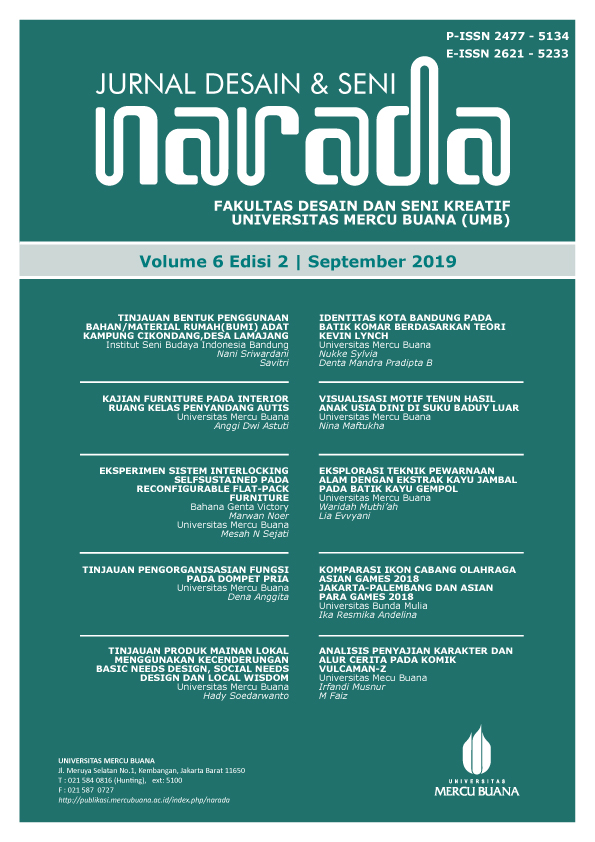
ANALISIS PENYAJIAN KARAKTER DAN ALUR CERITA PADA KOMIK VULCAMAN-Z
DOI:
https://doi.org/10.22441/narada.2019.v6.i2.010Keywords:
Peyajian Visual, Alur Cerita, “Vulcaman-Z”.Abstract
Analysis of Character Presentation and Storyline in the Comic "Vulcaman-Z" aims to find out and identify visually how the presentation of characters and storylines in the comic Vulcaman-Z by Galang Tirtakusuma. This comic is a 4 point comic (yonkoma) or four panels, a slapstick action-comedy genre that is rarely found in the Indonesian comics industry. This comic also has several unique features such as the use of layouts, characters, colors, expressions, action lines, and word balloons. This research uses a descriptive qualitative method with interviews, literature study and observation data collection methods. The purpose of this research is the initial research conducted jointly with students to uncover several Indonesian comic artists' styles which later become a study of revealing comic styles from Indonesia. As we know that Indonesian comics are still very influential with foreign comics, both Japanese and American. The comic style possessed by Indonesia does not yet have own characteristics, although some comic artists have tried to express the identity of Indonesia through cultural ornaments and stories. But the presentation and style of comics are still using or the same as the style that is outside. Based on this, this research is present as an effort to discover the characteristics of Indonesia in Comics or to give an idea to Indonesian comic artists to present new style contributions to Comics.
Downloads
References
Ame, T. (2013). Cara Mudah Menggambar Shoujo Manga. Jakarta: Transmedia Pustaka
Tirtakusuma, G. (2013). Vulcaman-Z. Bandung: CV Curhat Anak Bangsa
MakanKomik. (2013). Mastering Manga: A Mangaka’s Survival Guide. Surabaya: GentaCraft
McCloud, S. (2001). Memahami Komik. Jakarta: KPG Gramedia (Kepustakaan Populer Gramedia)
Geogernes, C. (2007). How to Cheat in Adobe Flash CS3: The art of design and animation. Oxford: Elsevier.
Irawan, B., & Tamara, P. (2013). Dasar-Dasar Desain. Jakarta: Griya Kreasi.
Rusdi, N., & Muhamad, A.S . (2017). Pengantar Sistem Manufaktur. Yogyakarta: Deepublish Publisher:Jurnal
Nasrullah, Rulli. Novita Sari, Intan. (2012). Komik sebagai Media Dakwah: Analisis Semiotika Kepemimpinan Islam dalam Komik “Si Bujang”. Vol 6, No 1 (2012). Diambil dari: http://journal.uinsgd.ac.id/index.php/idajhs/article/view/325/440. (Oktober, 2017)
Novianti,Nalti. (2007). "Dampak Drama, Anime, dan Musik Jepang Terhadap Minat Belajar Bahasa Jepang”. Vol 1, No 2 (2007). Diambil dari: http://journal.binus.ac.id/index.php/
Lingua/article/view/321 (Oktober, 2017)
Septiadi, Ng, William Surya. Suwasono, Arief Agung. Cahyadi, Jacky. (2016). “Perancangan Komik Strip Sebagai Media Layanan Masyarakat Untuk Bijak Dalam Bersosial Media”. Diambil dari https://www.neliti.com/publications/86489/perancangan-komik-strip-sebagai-media-layanan-masyarakat-untuk-bijak-dalam-berso (Oktober, 2017)
Artikel dan Website
Walker, Brian. (2002). The comics: since 1945. New York: Harry N. Abrams, Inc.
Anonim. (2017). Penyajian. Diambil dari:
http://kbbi.kata.web.id/penyajian/ (November, 2017).
Chris Lie. (2014). Cara mendisain karakter komik yang sukses. Diambil dari: https://www.kaskus.co.id/thread/53a9d11f902cfe26358b4614/cara-mendisain-karakter-komik-yang-sukses/ (November, 2017).
Gardner., T. (2006). Comic Vocabulary Definitions and Examples: Layout & Design. Diambil dari: http://www.readwritethink.org/files/resources/interactives/comic/comicdefinitions-design.pdf (Desember, 2017).
Gavaler, C. (2015). ANALYZING COMICS 101 (LAYOUT). Diambil dari: https://thepatronsaintofsuperheroes.wordpress.com/2015/12/07/analyzing-comics-101-layout/ (Desember, 2017).
Suzuki, M. (2016). CHIBI: THE JAPANESE WORD THAT'S CUTE and OFFENSIVE: THE ORIGINS, THE OFFENSIVE, AND THE OTAKU. Diambil dari: https://www.tofugu.com/japanese/chibi/
Downloads
Published
How to Cite
Issue
Section
License
A writer who will publish their article in the NARADA Journal of Design and Art agrees to the following conditions:
- The author owns the copyright and grants the rights to NARADA Journal of Design and Art as the party entrusted with publishing the article for the first time simultaneously licensed under the "Creative Commons Attribution-ShareAlike 4.0" License. This makes it possible for other people to share the work with a form of acknowledgment of authorship of the work and initial publication in this journal according to the authorship of the article provided.
- Authors may enter into separate additional contractual agreements for non-exclusive distribution of the published journal version of the work (e.g., posting it to an institutional repository or publishing it in a book) with acknowledgment of initial publication in the NARADA Journal of Design and Art.
- Authors are permitted and asked to post their work online (for example, institutional repositories or on personal websites) after the article publication process. This avoids double publication or multiple submissions which will affect the similarity of writing of the published work.
- In order to maintain the value of originality and similarity of articles sent or submitted. Authors are asked to temporarily remove or hide the original article from other online systems until they receive the results and decisions from the NARADA Journal of Design and Art regarding the decision to publish the article.
- The author, in this case the contributing author (Contributor Author), will be sent a form or letter stating the validity of the scientific work, signed on an IDR 10,000 stamp. Then the author will be asked to send the email to [email protected].
Pemberitahuan Hak Cipta
Seorang penulis yang akan menerbitkan artikelnya dalam NARADA Jurnal Desain dan Seni setuju dengan ketentuan berikut:
- Penulis memiliki hak cipta dan memberikan hak kepada pihak NARADA Jurnal Desain dan Seni sebagai pihak yang diberikan kepercayaan untuk mempublikasi artikelnya pertama kali secara bersamaan dilisensikan di bawah Lisensi "Creative Commons Attribution-ShareAlike 4.0". Hal ini memungkinkan kepada orang lain untuk membagi karya dengan bentuk pengakuan kepengarangan karya dan publikasi awal dalam jurnal ini sesuai dengan penulisan artikel yang diberikan.
- Penulis dapat membuat perjanjian kontrak tambahan yang terpisah untuk distribusi non-eksklusif versi jurnal yang diterbitkan dari karya tersebut (misalnya, mempostingnya ke repositori institusional atau menerbitkannya dalam sebuah buku) dengan pengakuan publikasi awal dalam NARADA Jurnal Desain dan Seni.
- Penulis diizinkan dan diminta untuk mempostingkan karyanya secara online (semisal, repositori institusional atau di situs web pribadi) setelah proses penerbitan artikel, Hal ini menghindari adanya double publikasi atau pengajuan jamak yang akan berpengaruh kepada adanya kesamaan penulisan dari karya yang diterbitkan.
- Demi menjaga nilai orisinalitas dan nilai kesamaan dari artikel yang dikirim atau diajukan. Penulis diminta untuk menghilangkan atau menyembunyikan secara sementara artikel orisinil dari sistem online lain yang sampai mendapatkan hasil nilai dan ketetapan dari pihak NARADA Jurnal Desain dan Seni mengenai keputusan publikasi dari artikel.
- Penulis dalam hal ini penulis kontributor (Contributor Author) akan dikirimkan form atau surat pernyataan keabsahan karya ilmiah, yang ditanda tangani di atas materai 10000. Dan selanjutnya penulis diminta untuk mengirimkan ke email [email protected].









