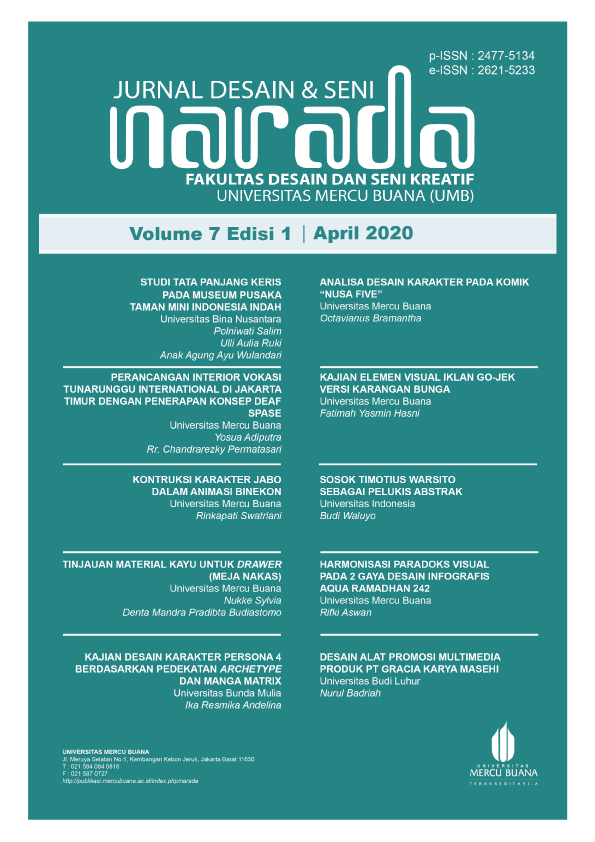
KAJIAN ELEMEN VISUAL IKLAN GO-JEK VERSI KARANGAN BUNGA
DOI:
https://doi.org/10.22441/narada.2020.v7.i1.007Keywords:
Visual study, advertising, online motorcycle taxi, GO-JEKAbstract
The development of the advertising world is now increasingly innovating in creativity. Advertising is a reflection of the image of a company, of course, the concept of creativity refers to the character of the company so that the delivery of messages can arrive according to the positioning of the mind of the audience. Various products and services have their strategies to strengthen their positioning. One of them is an application-based company called GO-JEK.
GO-JEK in its advertisement carries the theme of floral arrangements with the slogan #AnakBangsaBisa. In commemoration of the 73rd independence day of the Republic of Indonesia, GO-JEK expressed its gratitude to the sons and daughters of the nation who had inspired and succeeded in bringing Indonesian names to the ends of the world, even into space. This was revealed through the site and billboards themed flowers.
This study aimed to study the GO-JEK floral arrangement advertising design as a creative element of speech culture through floral arrangements in the advertising world. The method in this study is descriptive qualitative, which will examine the concept of visual strategy design in the advertisement applied by GO-JEK by reviewing the visual appearance related to color, the shape in the form of fields, illustrations, typography, icons/symbols, and layouts used. Output targeted in the study, the results of the research can be published in national-level journals.
Based on the above, the research reviews the GO-JEK advertisement version of the visual strategy of GO-JEK, to appreciate the development of contemporary advertising content, especially developments in the advertising world.
Downloads
References
Desain Komunikasi Visual; Dasar-Dasar Panduan Untuk Pemula. Bandung: Nuansa Cendekia.
Aswan, R. (2019). Tinjauan Elemen Visual Pada Buku Ilustrasi #88 Love Live. NARADA Jurnal Desain dan Seni, 6(1).
Baines, P & Dixon, C. (2003), Signs: Lettering in The Environment, London: Laurence King.
Calori, C, (2007), Signage and Wayfinding Design, New Jersey: John Wiley & Sons Inc.
Clow, K, E., James, K, E ., Kranenburg, K, E & Berry, C, T. (2009). An Examination of the Visual Element Used in Generic Message.
Advertisements: A Comparison of Goods and Services. Journal Services Marketing Quarterly, 30 (1), 69-84.
Creswell, J. W. (2010). Research design: pendekatan kualitatif, kuantitatif, dan mixed. Yogjakarta: PT Pustaka Pelajar.
Denzin, N, K & Lincoln Y, S. (2009). Handbook of Qualitative Research. Pustaka Pelajar: Yogyakarta.
Hadi, A, P. (2018). Perancangan Aplikasi Informasi Multimedia Tanaman Buah Kebun Raya Bogor Dengan Augmented Reality. NARADA Jurnal Desain dan Seni. 5(3).
Moriarty, S. (2009). Advertising, edisi kedelapan. Jakarta: Penerbit Kencana.
McQuail, D. (1997). Teori Komunikasi Massa Suatu Pengantar. Jakarta : Erlangga.
Noormega, R. (2018) “The Story Behind GO-
JEK Advertising Campaigns”. Diambil dari: https://medium.com/life-at-go-jek/the-story-behind-go-jek-advertising-campaigns-201884296d6
Rustan, S. (2009). Layout, Dasar & Penerapannya. Jakarta: Gramedia Pustaka Utama.
Rustan, S. (2014). Hurufontipografi. Jakarta: Gramedia Pustaka Utama.
Rohidi, T, R. (2011). Metodologi Penelitian Seni, Semarang : Citra Prima Nusantara.
Sanyoto, S, E. (2010). Nirmana Elemen-Elemen Seni Rupa dan Desain, Yogyakarta: Jalasutra.
Sudrajat, S, M. (2011), Dasar – Dasar Penelitian Ilmiah, Bandung: Pustaka Setia.
Downloads
Published
How to Cite
Issue
Section
License
A writer who will publish their article in the NARADA Journal of Design and Art agrees to the following conditions:
- The author owns the copyright and grants the rights to NARADA Journal of Design and Art as the party entrusted with publishing the article for the first time simultaneously licensed under the "Creative Commons Attribution-ShareAlike 4.0" License. This makes it possible for other people to share the work with a form of acknowledgment of authorship of the work and initial publication in this journal according to the authorship of the article provided.
- Authors may enter into separate additional contractual agreements for non-exclusive distribution of the published journal version of the work (e.g., posting it to an institutional repository or publishing it in a book) with acknowledgment of initial publication in the NARADA Journal of Design and Art.
- Authors are permitted and asked to post their work online (for example, institutional repositories or on personal websites) after the article publication process. This avoids double publication or multiple submissions which will affect the similarity of writing of the published work.
- In order to maintain the value of originality and similarity of articles sent or submitted. Authors are asked to temporarily remove or hide the original article from other online systems until they receive the results and decisions from the NARADA Journal of Design and Art regarding the decision to publish the article.
- The author, in this case the contributing author (Contributor Author), will be sent a form or letter stating the validity of the scientific work, signed on an IDR 10,000 stamp. Then the author will be asked to send the email to [email protected].
Pemberitahuan Hak Cipta
Seorang penulis yang akan menerbitkan artikelnya dalam NARADA Jurnal Desain dan Seni setuju dengan ketentuan berikut:
- Penulis memiliki hak cipta dan memberikan hak kepada pihak NARADA Jurnal Desain dan Seni sebagai pihak yang diberikan kepercayaan untuk mempublikasi artikelnya pertama kali secara bersamaan dilisensikan di bawah Lisensi "Creative Commons Attribution-ShareAlike 4.0". Hal ini memungkinkan kepada orang lain untuk membagi karya dengan bentuk pengakuan kepengarangan karya dan publikasi awal dalam jurnal ini sesuai dengan penulisan artikel yang diberikan.
- Penulis dapat membuat perjanjian kontrak tambahan yang terpisah untuk distribusi non-eksklusif versi jurnal yang diterbitkan dari karya tersebut (misalnya, mempostingnya ke repositori institusional atau menerbitkannya dalam sebuah buku) dengan pengakuan publikasi awal dalam NARADA Jurnal Desain dan Seni.
- Penulis diizinkan dan diminta untuk mempostingkan karyanya secara online (semisal, repositori institusional atau di situs web pribadi) setelah proses penerbitan artikel, Hal ini menghindari adanya double publikasi atau pengajuan jamak yang akan berpengaruh kepada adanya kesamaan penulisan dari karya yang diterbitkan.
- Demi menjaga nilai orisinalitas dan nilai kesamaan dari artikel yang dikirim atau diajukan. Penulis diminta untuk menghilangkan atau menyembunyikan secara sementara artikel orisinil dari sistem online lain yang sampai mendapatkan hasil nilai dan ketetapan dari pihak NARADA Jurnal Desain dan Seni mengenai keputusan publikasi dari artikel.
- Penulis dalam hal ini penulis kontributor (Contributor Author) akan dikirimkan form atau surat pernyataan keabsahan karya ilmiah, yang ditanda tangani di atas materai 10000. Dan selanjutnya penulis diminta untuk mengirimkan ke email [email protected].









